Wednesday, May 2, 2012

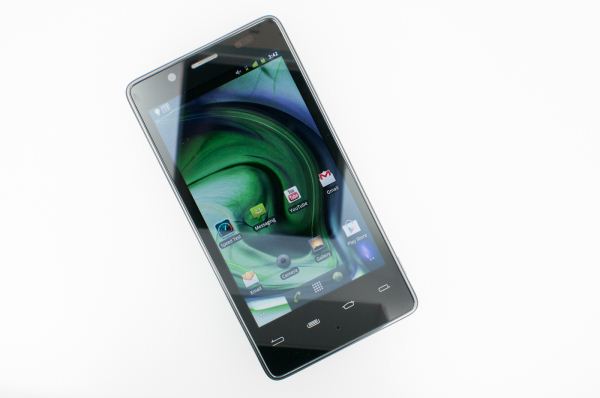
Lava Xolo X900

 
For Intel, the road to their first real competitive smartphone SoC has been a long one. Shortly after joining AnandTech and beginning this journey writing about both smartphones and the SoC space, I remember hopping on a call with Anand and some Intel folks to talk about Moorestown. While we never did see Moorestown in a smartphone, we did see it in a few tablets, and even looked at performance in an OpenPeak Tablet at IDF 2011. Back then performance was more than competitive against the single core Cortex A8s in a number of other devices, but power profile, lack of ISP, video encode, decode, or PoP LPDDR2 support, and the number of discrete packages required to implement Moorestown, made it impossible to build a smartphone around. While Moorestown was never the success that Intel was hoping for, it paved the way for something that finally brings x86 both down to a place on the power-performance curve that until now has been dominated by ARM-powered SoCs, and includes all the things hanging off the edges that you need (ISP, encode, decode, integrated memory controller, etc), and it’s called Medfield. With Medfield, Intel finally has a real, bona fide SoC that is already in a number of devices shipping before the end of 2012.

In both an attempt to prove that its Medfield platform is competitive enough to ship in actual smartphones, and speed up the process of getting the platform to market, Intel created its own smartphone Form Factor Reference Design (FFRD). While the act of making a reference device is wholly unsurprising since it’s analogous to Qualcomm’s MSM MDPs or even TI’s OMAP Blaze MDP, what is surprising is its polish and aim. We’ve seen and talked about the FFRD a number of times before, including our first glimpse at IDF 2011 and numerous times since then. Led by Mike Bell (of Apple and Palm, formerly), a team at Intel with the mandate of making smartphone around Medfield created a highly polished device as both a demonstration platform for OEM customers and for sale directly to the customer through participating carriers. This FFRD has served as the basis for the first Medfield smartphones that will (and already are) shipping this year, including the Orange Santa Clara, Lenovo K800, and the device we’re looking at today, the Lava Xolo X900. Future Medfield-based devices will deviate from the FFRD design (like the upcoming Motorola device), but will still be based loosely on the whole Medfield platform. For now, in the form of the X900 we’re basically looking at the FFRD with almost no adulteration from carriers or other OEMs.

for anandtech.com

Thursday, April 19, 2012

Lumia 900


A short time after the Lumia 900 went on sale, users started reporting data connectivity issues affecting both 3G HSPA+ and 4G LTE on AT&T. Although I didn't encounter these on my review unit, Nokia acknowledged the issue a short time after and stated that an update would be available on April 16th, in addition to a $100 credit through April 21st.

Today, Nokia has beat its own estimates and made the Lumia 900 update available through Zune and the Mac desktop connector for Windows Phone 7. This update resolves the memory management issue that led to intermittent cellular data on the Lumia 900 previously.

Source: Nokia

Saturday, March 31, 2012

PlayStation 4 using AMD


Features and Specs Updates PlayStation 4

  • According to the website's source, the PlayStation Orbis will have both a CPU and a GPU made by AMD, with the graphics being based on the recently released Southern Islands cards for the PC.
  • This improved hardware will allow the console to display graphics at a resolution of up to 4096 x 2160 and 3D images at a full HD 1080p resolution.
  • The report also mentioned that more and more prototypes of the console are being sent to selected developers across the world so that they can start working on games for the new home console.
  • Projects surround the PlayStation 4 have been in development for quite some time now. Game design news site Develop reported in October that preliminary work on titles for the upcoming console was underway in Sony studios. The source told Develop that these projects were in very early stages.
  • Unfortunately for existing PS3 owners, the Orbis would not have any sort of backwards compatibility with games for the current device, which means early adopters would not have lots of things to play on it. According to a Slashgear report, the Orbis will not be working with any games from previous consoles at all, depending solely on games that are release after the console itself.
  • Just like with a previous rumor concerning the next generation Xbox console, it seems that the Orbis will have a system in place to prevent used gaming, similar to the one seen with current PC games.
  • Games for the console will arrive either on a Blu-ray disc or as digital downloads. Once the user gete a retail game and place it into their console, they would need to activate it online and tie it to their PlayStation Network account, which means the user would be able to download it from the PS Store in case something happens to the Blu-ray disc.
  • Those who buy used copies of a game might be served with a trial version or be forced to pay a certain amount of money in order to unlock the full title, but actual details aren't clear just yet.

Sources :IBTimes

Photo :Playstation4talk.com